
PRODUCTS / PNEUBEND
TUNGSTEN CARBIDE
HARDFACED
PIPE BENDS
Explore proposed sizes, materials, bend angles, connections and technical information for this PneuBend family.
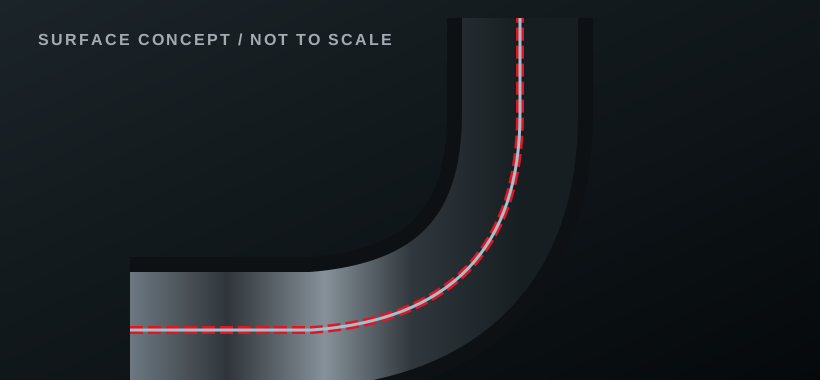
PNEUBEND / ENGINEERING
DN50–DN400
Nominal sizes
30° / 45° / 90°
Angles
Multiple
Standard radii
3
Base metals
TECHNICAL DETAILS
Tungsten Carbide Hardfaced Pneumatic Conveying Pipe Bends
Review the complete tungsten carbide hardfaced pipe bends content below. All specifications and product claims remain subject to approval before publication.
Wear Protection by Tungsten Carbide Weld Overlay
This product family uses a tungsten-carbide-containing hardfacing system in selected high-wear areas of a pipe bend. The intended purpose is to provide a more abrasion-resistant internal surface than the untreated substrate. It differs from an inserted ceramic liner because the protective layer is deposited or attached through a qualified hardfacing process.
Material formulation matters: hardfacing alloys can differ widely in carbide content, binder matrix, deposit structure, crack behavior and repairability. The particular PneuBend process and suitability for each substrate remain subject to qualification.
Sizes DN50–DN400 and 30°, 45° or 90° Deflection
A broad nominal connection range is proposed. Each finished bend must meet defined minimum bore, wall thickness and installation tolerances after hardfacing. Inner-surface access for applying and inspecting overlays needs special review on tight-radius or small-bore bends.
Fixed Centerline Radius Options
| Nominal DN | Compact CLR (mm) | Standard CLR (mm) | Extended CLR (mm) |
|---|---|---|---|
| DN50 | R250 | R500 | R750 |
| DN65 | R300 | R500 | R750 |
| DN80 | R300 | R500 | R750 |
| DN100 | R400 | R750 | R1000 |
| DN125 | R500 | R750 | R1250 |
| DN150 | R600 | R1000 | R1500 |
| DN200 | R750 | R1250 | R2000 |
| DN250 | R1000 | R1500 | R2500 |
| DN300 | R1250 | R2000 | R3000 |
| DN350 | R1500 | R2500 | R3500 |
| DN400 | R1500 | R2500 | R4000 |
Candidate common catalog for the five pipe-based families. Manufacturing and lining feasibility not yet approved. All dimensions in millimetres.
A CLR option is not accepted for a given size until both bend forming and interior overlay access have been verified. Deposit thickness can change the usable bore and the flow geometry, particularly near the outer curve.
Carbon Steel, AISI 304 and AISI 316 Substrates
Proposed substrates are carbon steel, AISI 304 and AISI 316. Hardfacing consumables, dilution, heat input, weld procedures and crack tolerance must be evaluated for the selected base alloy. Do not assume that a process developed for carbon steel is automatically suitable for stainless steel.
Flanged and Straight Pipe-End Connections
Both plain pipe ends and DIN/EN or ANSI/ASME flange configurations are proposed. The drawings should show whether the overlay continues to the ends, how internal transitions are prepared and whether any finishing allowance is required.
Overlay Process, Thickness and Coverage
Coating Method and Deposit
The final offer should identify the qualified weld-overlay process, nominal minimum deposit thickness, approved material composition and accepted surface finish. These parameters are not published as numerical guarantees in this draft.
Wear-Protection Coverage
Depending on erosion mapping and installation orientation, the required protection may cover the outer arc, a broader sector or the full accessible bore. Partial coverage needs a clear drawing showing the protected area and its termination.
Inspection and Repair
Inspection can include dimensional checks, visual condition and other tests appropriate to the weld overlay. Maintenance documentation should define how localized defects or worn regions are evaluated rather than prescribing field repair without an approved procedure.
Applications and Engineering Limits
Hardfaced bends may be considered for severe dry-solid abrasion where a metallic substrate and deposited wear layer meet the duty. Evaluate impact energy, corrosion, operating temperature, cleaning chemicals and erosion immediately downstream.
Technical Specifications and Quote Request
| Parameter | Proposed launch configuration |
|---|---|
| Family | Tungsten Carbide Hardfaced Bend |
| Geometry | Curved or approved fabricated pipe with WC-containing overlay |
| Nominal size | DN50–DN400 |
| Flow deflection | 30°, 45°, 90° |
| Base materials | Carbon steel; AISI 304; AISI 316 |
| Connections | Plain pipe; EN/DIN flange; ANSI/ASME flange |
| Bend radius | Candidate fixed CLR per DN; overlay feasibility to be confirmed |
Availability, actual finished bore, wall thickness, pressure/temperature limits, flange drilling, mass and accepted manufacturing combinations are confirmed on an approved quotation and drawing.
ENGINEERED FOR YOUR PROCESS
HAVE A CONVEYING CHALLENGE?
Share your material, dimensions and operating conditions. Our team can review the proposed bend configuration.